Background

The purpose of this blog is to discuss your health and wellness. Everything from nutrition, to manual therapy, to CrossFit to Functional Movement Systems as well as pain and injuries.

Mini-Bio
I was raised in northern Virginia and played every sport they'd let me. I injured my low back/hip while playing baseball at Radford University in Virginia. I was treated by a physical therapist, an orthopedic, a primary care md, and an athletic trainer, but no one made the difference for me until I got chiropractic treatment. That day I knew what I wanted to do with my life. I'm a fitness consultant and sports chiropractor in South Florida and I'm dedicated to helping people maintain the well-oiled machine that their bodies could be. I'm certified as a Functional Rehab specialist, a Titleist Performance Institute golf fitness specialist, an Active Release Technique provider as well as a former personal trainer. To contact me, log onto www.mobility-4life.com or email me at drscotthoar@gmail.com
Showing posts with label knee pain. Show all posts

Wednesday, May 14, 2014

Crossfit: How Manual Therapy Can Get You to Regionals Next Year (or just keep you out of pain)!

Whenever I notice Rich Froning, or Jason Khalipa, Julie Foucher or any one of the bigger named crossfitters in the middle of a competition, I always marvel at how effortless their technique looks.  They really have fantastic form and technique, which creates less stress on their body so they can perform faster and harder than....well....you.

If you find yourself doing all the corrective exercises and stretching in the world but it still doesn't make the difference, you'll want to read this.  You'll find out how you've been trying to eat your bowl of soup with a fork....it just doesn't work.

"My shoulders are just too tight".....Not anymore!
When you injure yourself, whether in a specific event (like a hamstring strain) or over a long time (like 'I've always had tight upper back muscles), your body lays down what we call 'fibroblasts' in your muscle due to the lack of oxygen deliverance.  What happens when you accumulate fibroblasts?  Instead of your muscles and soft tissue being stretchy like a rubber band, they end up being tough like a piece of leather. 


Then suddenly you find yourself saying 'I'm just not flexibile enough' or 'I'm just too tight'.  Well...you are.  The problem is that corrective exercise cannot get rid of the fibroblasts.

So what can?  Manual therapy!

The two manual therapies I'd like to highlight in particular would be Active Release Technique (ART) and Graston Technique.

Active Release Technique - a hands on technique performed by a chiropractors or physical therapist that brakes up fibroblasts through tension techniques in which you move your own body during the treatment. 

Graston Technique - a steel instrument used over the skin designed to soften up scar tissue, and re-start the inflammatory process which will normalize your muscles and other tissues.  It's perfect for tennis elbow, plantar fasciitis, achilles pain, and other more tendon-based injuries.

Both of these techniques are designed not only to improve flexibility, but also too relieve your pain and decrease injuries.  Maybe it will make the difference in the depth of your squat, how far you can get your shoulder back during a kip or overhead squat.  Maybe it'll even get you into regionals!

If you are in the Boca Raton area and would like ART or Graston, please visit me at www.Mobility-4Life.com




Thursday, April 24, 2014

Injury Free- Box Jumps

Box Jumps are a fantastic way to exercise.  It's a whole body exercise that works on your strength, power, conditioning and burns fat.  Unfortunatley many people struggle with them and end up hurting themselves.  Here are a few quick tips to get you in performing box jumps without hurting yourself (and having better performance too!)

1.  Swing Your Arms
        When one jumps, it's not the ability to push the ground down that has you jump high.  People with huge squat one rep maxes aren't the people that can jump the highest.  It's the ability to coordinate all your forces upward while transferring your forces through your core.  A highly effective way of accomplishing that is by getting a great deal of momentum going with your arms.  The more force your arms create, the less your hips, knees and ankles have to.  It's a fantastic way to keep the stress off your body.

2.  Don't Let Your Knees Travel Inward

Whether its your takeoff, or your landing, don't let this happen.  You might even want to concentrate on having your knees travel to directly away from each other, as this increases stability in the foot, ankle, knee complex.  It will minimize the stress on your body.

3.  Step Down
         Now if you're a highly competitive Crossfit type you might not like this one.  It's true that if your just going for performance, jumping down is faster.  However it adds so much force to the calf, achilles tendon, ankles and plantar fascia that it significantly increases the chances of you injuring yourself.  Alternating which foot you step down off the box will allow you to minimize the stress on your body without wearing down either leg.  

If you have any questions or are injured, please email me at drscotthoar@gmail.com.  If you are in the Boca Raton area, you can visit us at www.Mobility-4Life.com

Wednesday, October 23, 2013

Iliotibial Band Syndrome

Notice the iliotibial band is not a muscle
A common complaint that presents in my office is pain on the outside portion of the knee.  Some people refer to this as ITB or Iliotibial band syndrome.  It's very common with runners, crossfitters and fitness enthusiasts of all kinds.

So here's what happens.  Typically you are someone who does a very high amount of repetitive exercise.  Historically this has mostly been present with runners.  However lately I've been seeing it with crossfitters, particularly those who practice a very high volume of olympic lifts with dysfunctional technique.  

One thing that runners and crossfitters have in common is a limited amount of single leg strengthening activities. (Pistols being the only exception regarding crossfit).  When you don't utilize single leg strengthening exercises you tend to have limited abilities to stabilize the hip.

With that lack of stability at the hip, there is increased shear motion at the hip joint.  So in an attempt to control the movement, the Tensor Fascia Lata and Gluteus Medius muscles (smaller hip stabilizers) get overpowered and the stress is carried down through the iliotibial band all the way down to the attachment just below the outside of the knee.  So that attachment has to work hard to try to stabilize the knee AND hip and it just gets overburdened and inflamed and bam! You've got ITB syndrome.

It's really a pretty unique syndrome seeing that the iliotibial band is not a muscle, it's just a dense collection of connective tissue.  That's why people that have tried to massage or stretch the IT band end up frustrated because it doesn't work.

Two things to watch out for with ITB syndrome:


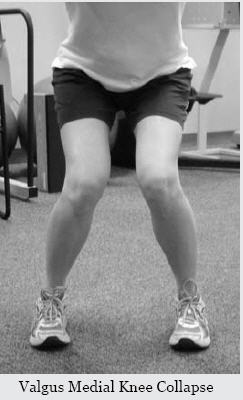
1) When the knee travels excessively toward the mid line of the body during any weight bearing movements.  This includes Olympic lifts, running, jumping, squatting, etc.  In the clinical world we call this a 'Valgus Collapse'.  The example picture is a gross example.  It's very common to see a much more subtle inward 'bounce' of the knee especially while returning to the standing position during something like deep squats or Olympic lifts.


2) Exercise Programming that lacks single leg exercises.  Examples of exercises would be lunges, pistols (single leg squat) single leg deadlifts, single leg jumps, etc.

Single Leg Deadlifts


If you have any questions or are in the Boca Raton area and would like to schedule an appointment please dial 561.997.8898 or email me at drscotthoar@gmail.com.  To check out more visit www.Mobility-4Life.com

Tuesday, August 13, 2013

Staying in Shape While Injured

Maintaining you physique and fitness levels while injured can be a tricky thing to do.  I always recommend substituting non-painful exercises for the ones you know bother you, or you just don't do so well.


Here's an article to check out regarding how exactly to do that.  http://www.backtothebox.com/how-do-i-fit-my-prehab-or-rehab-into-my-physical-performance-program-4/  

This is a bit 'Crossfit-oriented' but his template can be utilized in any exercise program you choose.  Happy reading!  

If you have any questions please contact me at drscotthoar@gmail.com.  To check out more visit www.Mobility-4Life.com

Wednesday, March 6, 2013

Burpees

The Burpee has gotten so much press the last number of years that even though I've touched on it twice before, I think it deserves it's own post.  It's literally one of my favorite exercises out there.  Why?  You don't need any equipment and it tones, conditions, and shreds people!  Plus, I always have a tendency to like exercises that really expose people's mobility and stability shortcoming.  That's why I like Overhead deep squats too.  You have to have all regions of your body working well to do it well.  But I digress.  Burpees.

Burpees are a combination movement where you start in a standing position, jump down to a lowered pushup position (chest touching the ground), kip your feet to a full squat position, then jump up and clap your hands above your head.

I love burpees because if I have an extremely full day when I know I won't be able to get to the gym,  I know I can do 4 minutes of burpees and get a hell of workout and feel good about myself the rest of the day.

Here's the problem.

People don't do them very well.

The main issues I see that would lead to injury is that people do not come to the full deep squat position.  When they jump up they have the feet too close together, their heels are elevated, and all the stress of the movement goes straight to the knees and the quads.  When you are in a deep squat position (like you should be) the stress of the movement goes to the glutes and the hips (which can handle the load without causing injury).


If you notice that you can't get in a full squat position, then there is something wrong with either your foot, ankle, hips, or body control and you need to be evaluated by a movement professional.  If you're in the South Florida/Boca Raton area you can schedule your own personal evaluation either at 561.997.8898 or by emailing me personally at drscotthoar@gmail.com. To check out more visit www.Mobility-4Life.com